“Success has many fathers, while failure is an orphan.” This is a truism that Leah McGrath Goodman would have done well to consider before she “outed” Dorian “Satoshi” Nakamoto.
Goodman’s March 6, 2014, cover story, which putatively identified this bewildered 64 year old as “The Face Behind Bitcoin,” was touted as the resurrection of Newsweek, the 81-year-old newsmagazine that had suffered two near-death experiences since 2010. Instead, after Nakamoto’s steadfast rebuttal of any involvement with the digital currency that suffered its own near-death experience in February 2014, both Goodman and her employer were left laughingstocks.
It is known for certain that Bitcoin was introduced to the world first as concept then as software, in 2008 and 2009, respectively, by “Satoshi Nakamoto.” Who or what this phantom billionaire is (or was) remains a total mystery. He is almost certainly not the retired engineer chased down to a Los Angeles suburb by Goodman. Various people around the world have been fingered as Bitcoin’s father, but all have denied paternity.
Bitcoin is described as a means of exchange, an alternative currency or as property. It is those things, but it can also be considered the last great bust of the dot-com boom, an example of “tulip mania” or millennial enthusiasm, a fevered projection of the New Media, a means to money laundering or even a mystery religion. Or you could call it the scam of the century.
It is surely no accident that Bitcoin as concept appeared two months after the bankruptcy of investment banker Lehman Brothers. The World As We Know It (economically) almost came to an end in 2008-09. Many believe that the rescue efforts made by governments around the world to forestall disaster have only delayed it and that the coup de grâce—either massive deflation or hyperinflation—is only a matter of time.
Bitcoin offered a way out, if only for the remnant clever enough to adopt it. The continuing economic crisis has been blamed on, with good reason, the foolishness of central bankers and governments and the greed and outright fraud of the Masters of the Universe, the globalist financial elite that has dominated world finance since the 1980s.
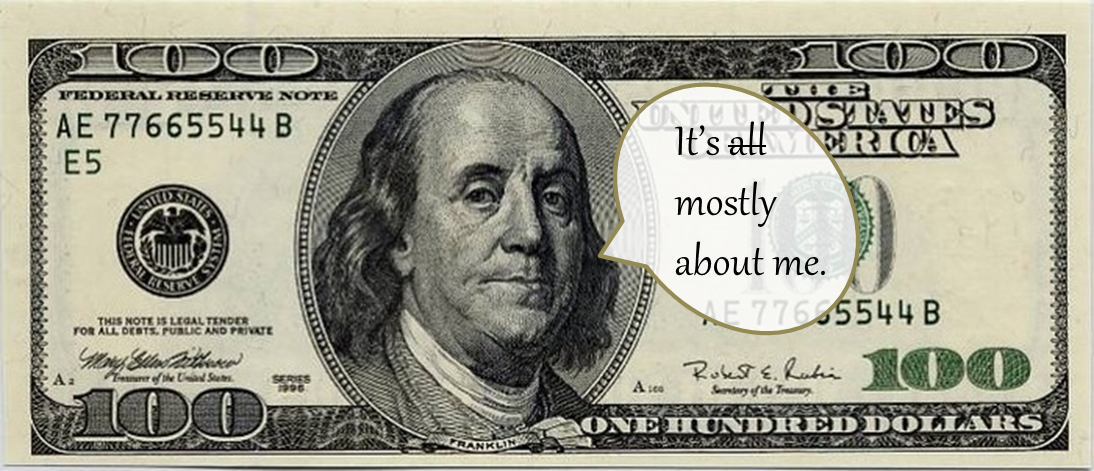
Money may make the world go round, but what is money? For most of us, most of the time, it is fiat currency or “paper” (now increasingly plastic) money. This is what we have in our wallets and bank accounts and what our financial instruments (credit, stocks, bonds, etc.) are measured in. “Fiat” is Latin for a demonstration; in other words, an American “Benjamin” is worth $100 because the United States government says so.
The U.S. dollar was backed by gold until 1971, when Richard Nixon set it free. Paper money now has no intrinsic worth; it is subject to counterfeiting, to theoretically infinite multiplication (see Zimbabwe, circa 2001-09) and to government manipulation. And access to “your” money is dependent on the vagaries of “fractional-reserve banking,” wherein financial institutions routinely lend 40, 50 or 100 times the money they actually have (see It’s A Wonderful Life).
Fiat currency is relatively new in human history. Previously, money meant gold or silver. These metals do have intrinsic value. Their mining and refining is difficult and expensive, so multiplication is not a serious problem. Precious metals, however, are subject to speculation and manipulation. In addition, gold and silver bullion are heavy; storage is problematic; and government confiscation is a threat (see Franklin Delano Roosevelt, 1933).
Gold and silver exchange-traded funds (ETFs) are often called "paper gold" and silver. This is not a compliment, and it is no coincidence that that the Chinese and Indians disdain them and favor the real thing.
Bitcoin was meant to be an ideal currency. Unlike gold and silver, it is not a commodity; it is entirely theoretical, widely distributed and internally regulated over a global network of computers, protected by cryptography and thus theoretically free from the machinations of central bankers and governments. It is not subject to infinite multiplication, as the number of bitcoins is capped.
You can call it Internet money, and therein lays its appeal. Friedrich Engels, Karl Marx’s intellectual partner, wrote in 1878 that the State would “wither away.” This is perhaps the worst famous prediction ever made, with the second-worst being Bill Clinton’s “The era of big government is over.”
As one would expect, libertarians, anarchists and survivalists flocked to Bitcoin. It was new; it was pure; and it was (so we were told) the latest “Triumph of the Nerds.” The nerds had given us the transistor, the integrated circuit, the personal computer and (with some government help) the World Wide Web. Coincidental with the apotheosis of Big Government (never bigger than after 2008) the nerds had given us an alternative—a decentralized community of communities, peoples of all classes, colors, creeds and countries united not by force but by voluntary affinities.
So what could be more logical than Internet money, Bitcoin? So powerful was this idea that banks and governments were said to be “scared” of it. It didn’t seem to occur to Bitcoin’s champions, however, that Big Government is a jealous god. Or that just as the Internet give us the ability to discover everything about the world, it gives governments the ability to find out everything about us. Or that the U.S. dollar is the world’s reserve currency for a reason.
More to the point, Bitcoin’s champions hadn’t considered that investing billions in a currency controlled by a proprietary algorithm developed by a mystery man who may or may not exist was perhaps a trifle risky. Or that investing billions in a Bitcoin exchange that originated as a trading post for devotees of a dungeons-and-dragons card game smacked of the fantastic.